
Trust in care isn’t broken. We’re just forgetting how to show up.

Over the past month, I have been in a lot of conversations about trust. In Modena with the FACILITATE team, the discussion centered on what it means to return individual trial data in ways that center participants instead of systems. On a BioNews panel, the focus turned to “levers” for trust with rare disease communities. At a virtual IRB conference, I gave a keynote on informed consent that pushed attendees to think beyond the form and shift from disclosure to understanding.
Different settings, different audiences, same core question: how do we build and sustain trust in care?
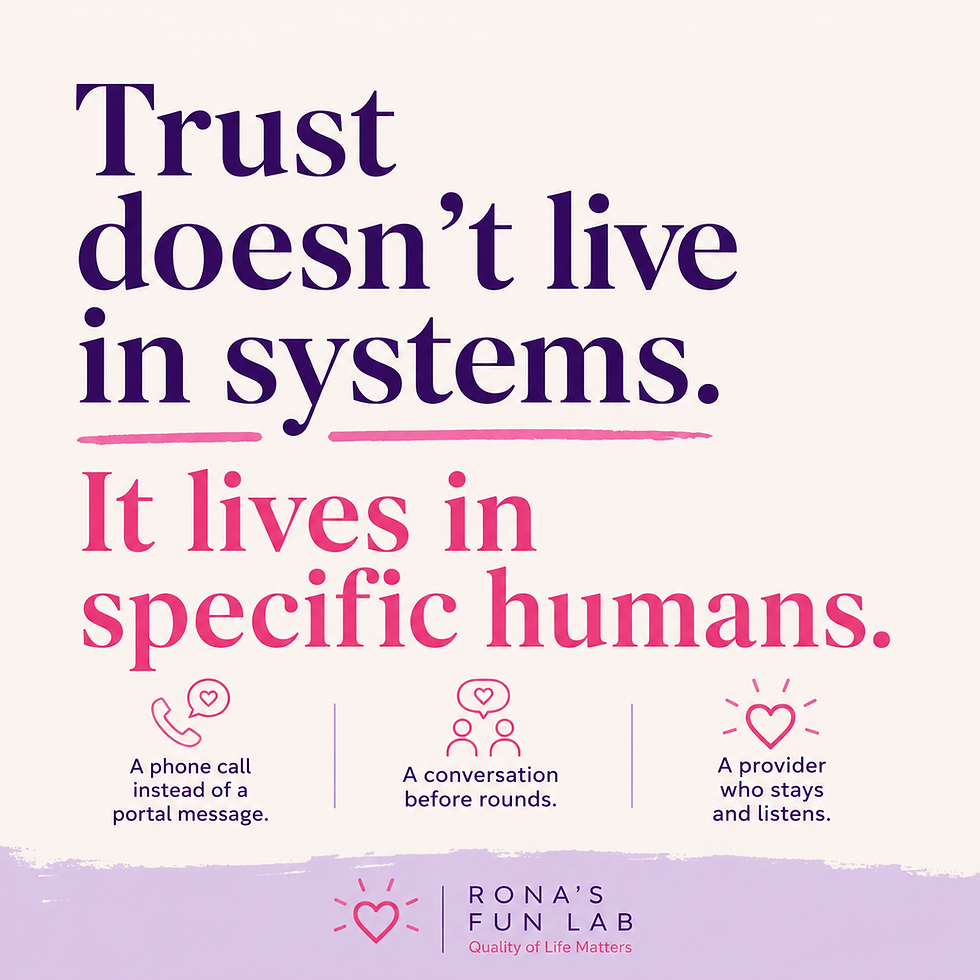
Strip away the slide decks and frameworks, and the answer becomes much simpler and much more personal. As a parent, trust did not live in institutions, platforms, or processes. It lived in specific humans: the doctors who showed up in the hardest moments, who listened when it would have been easier to move on, who crouched down to catch up with Rona before standing to talk to her parents.
That is the backbone of trust. And it is the piece that we seemingly keep trying to automate, outsource, or design away.
During Rona’s treatment, we spent a great deal of time in hospitals and clinics that prided themselves on being at the cutting edge of precision medicine and clinical research. I signed sets of two consent forms for times for trials. Portals and platforms promised streamlined communication and greater efficiency. On paper, the environment was saturated with innovation.
In reality, the moments that endured were small and deeply human.
There was the resident who spent at least 5 minutes with us talking every morning before rounds, even though it made the conversation take longer. I always trusted him to represent what had actually happened in the room overnight to the attending.
There was the anesthesiologist who talked to Rona about Gabby’s Doll House while she escorted her to an operating room we could not visit, because Rona was five and needed to be treated like a five-year-old, not a diagnosis. Rona was so into the conversation that we later learned the last thing she said when the medication hit was, “Oh! I’m in the dollhouse.”
There was the PA who always called instead of simply dropping life-altering results into MyChart, because she understood that information without context is its own kind of harm. And she knew after getting our first set of lab results back without context, I couldn’t bring myself to login again. (I still can’t.)
These are not small things. Work on patient-centered care and communication has shown that how clinicians communicate—verbally and nonverbally—strongly shapes trust, understanding, and adherence.²⁻⁴ In pediatrics, studies on language and prognostic communication show that parents anchor to specific phrases and the emotional tone of conversations long after they forget lab values or protocol names.⁵⁻⁷
When people ask which doctors were trusted, the answer is not titles. It is behaviors:
The ones who slowed down in the room where everyone else was rushing.
The ones who answered the real question—“Is this going to work?”—instead of hiding behind probabilities.
The ones who acknowledged the stakes out loud, instead of pretending this was just another day at work.
Trust was never abstract. It lived in those moments.
Professionally, I have spent years working in clinical research, including guiding thousands of people through informed consent forms. There are good arguments for streamlining documents, improving readability, and digitizing signatures. Those changes are needed. But they are not sufficient.
In many rare diseases, a clinical trial is not one option among many; it is the only path forward. Ethics and policy work have been clear that in these situations, voluntariness is more fragile, and consent must be understood as a process, not a transaction.¹,⁸⁻¹¹ Under stress, sleep deprivation, and anticipatory grief, comprehension fluctuates; simplifying forms alone does little without the ongoing conversations that support understanding over time.¹⁰,¹¹
And yet, as a field, most energy still gets invested in the mechanism—the form, the portal, the platform.
Forms get shortened and reformatted, but time for conversation does not get protected.¹,⁸,¹¹
New portals send more automated messages, but do not make it easier for families to reach a human who knows their story.²⁻⁴
New tools for “site support” create more logins, more dashboards, and more invisible work for already-stretched staff.
The result is predictable. Families feel like they are interacting with systems instead of humans. Sites feel buried. Communities are told that “we care about trust,” while their actual experience is one of distance and delay.
The field says it does not have time to talk to patients—and then acts surprised when participation, retention, and long-term engagement erode.⁴
Some of the clearest lessons about trust came from the hardest days of Rona’s care.
On the day it became clear she would need a transplant, the conversation shifted from “this is moderate” to survival probabilities and the 100 days of isolation ahead. Nothing can prepare a family for that pivot. In that moment, what stayed was not the statistics, but the words a provider chose—and how they were delivered. The language did more than convey information; it framed how that day now lives in memory.⁵⁻⁷
Later in the journey, when the prognosis worsened, the question became one no parent wants to ask: “Is this going to work? Because it feels like she’s going to die.” The answer mattered, of course. But what mattered just as much was the willingness to meet the question head-on, to sit with it instead of redirecting back to protocols or percentages.
Research backs this up. Families consistently report that clear, direct, compassionate communication—even when the news is devastating—supports trust and helps them make meaning in real time.⁵,⁶,¹² Euphemism and avoidance may feel kinder in the moment, but they often leave a residue of confusion and regret.⁷,¹²
The doctors trusted most did not make the news better. They made it bearable to carry.³
So where does this leave the people working in healthcare, research, and health tech who genuinely want to improve trust?
Across these recent events—and across the years spent as Rona’s mom—the answer keeps coming back to three simple, hard commitments.
Protect one real conversation for every critical decision. For every major treatment or trial decision, there should be at least one dedicated conversation where patients and families can ask questions in real time. Not a rushed hallway update, not an auto-released result, but protected space. This is where nuance, emotion, and meaning-making live—and where communication quality has been repeatedly linked to trust, satisfaction, and even outcomes.²,³,¹³,¹⁴
Design technology to create human touchpoints, not erase them. Before launching another portal, chatbot, or digital consent platform, ask: “Where are the warm handoffs?” How does this tool make it easier for a family to get to a person who knows them? How does it flag distress or confusion in a way that triggers outreach, not just another notification? Work on patient-centered care and shared decision-making keeps pointing in the same direction: tools should extend relationships, not replace them.²,³,¹³,¹⁴
Ask patients, families, and sites what gets in the way of trust before adding anything new. True co-design means bringing in the people who will carry the burden—families and front-line staff—at the beginning, not at the end. Patient-engagement literature shows that when lived experience shapes study design and infrastructure, recruitment, retention, and relevance all improve.¹⁵⁻¹⁸
None of this is as shiny as an AI roadmap or a new platform launch. It does not always scale neatly. It can be uncomfortable and slow. But it is also the work that actually moves the needle.¹³,¹⁴
In rare disease and complex care, trust often gets discussed as something to be measured and optimized—another KPI, another line on a dashboard, another index to publish. Measurement matters. But sometimes, in the rush to quantify trust, it becomes easy to forget how it is actually lived.
For this family, trust in care was not a score. It was a collection of moments:
A doctor crouched at the bedside instead of standing in the doorway.
A phone call instead of a portal message.
A provider willing to answer, “Is this going to work?” as honestly as possible, even when the answer hurt.⁵⁻⁷
If families and communities are going to trust healthcare systems enough to enroll in trials, to stay in care, and to recommend organizations to others, that trust has to be earned the old-fashioned way. Not just with better tools, but with better conversations. The broader literature on patient-centered care and shared decision-making keeps reinforcing this: trust is the foundation of effective care and collaboration, not a nice-to-have.
The good news is that the field already knows how to do this. These conversations have been happening for years. The question is whether they will be prioritized, protected, and used to shape everything else.
Because in the end, trust in care will not be restored by the next platform or policy alone. It will be restored in the rooms where people are willing to slow down, see each other clearly, and tell the truth.
Selected references
American Medical Association. Informed Consent Guidance.
Epstein RM, Street RL. The values and value of patient-centered care. Ann Fam Med.
Street RL et al. How communication heals. Patient Educ Couns.
Zolnierek KBH, DiMatteo MR. Physician communication and patient adherence to treatment. Med Care.
Mack JW et al. Communication about prognosis. J Clin Oncol.
Bluebond-Langner M et al. Parent–child communication at end of life. Pediatrics.
Mayo Clinic Proceedings Editorial Board. Language at the end of life: why words matter. Mayo Clin Proc.
Beauchamp TL, Childress JF. Principles of Biomedical Ethics.
Appelbaum PS et al. Therapeutic misconception. IRB: Ethics & Human Research.
Flory J, Emanuel E. Interventions to improve informed consent. JAMA.
Nishimura A et al. Improving understanding in informed consent. BMC Med Ethics.
Wolfe J et al. Parents’ preferences for communication at the end of life for children with cancer. JAMA.
Institute of Medicine. Crossing the Quality Chasm: A New Health System for the 21st Century.
Barry MJ, Edgman-Levitan S. Shared decision making—the pinnacle of patient-centered care. N Engl J Med.
Domecq JP et al. Patient engagement in research. J Gen Intern Med.
Crocker JC et al. Impact of patient involvement on clinical trials. BMJ.
Sacristán JA et al. Patient-centric drug development. Nat Rev Drug Discov.
PCORI. Engagement Rubric; FDA. Patient-Focused Drug Development Guidance.


Comments