
When Isolation Meets Imagination: Skittles, PTSD, and What Living in a Pediatric ICU Really Looks Like

June is PTSD Awareness Month. For most people, PTSD calls to mind combat veterans or survivors of violent trauma. But there's another population quietly living with post-traumatic stress disorder: children who spend weeks or months in pediatric intensive care units, and their families.
Research shows that up to 28% of children develop PTSD following admission to a PICU, with symptom rates significantly higher at up to 62% (Colville, G., & Pierce, C. Intensive Care Medicine, 2012). For parents, the numbers are even more striking—up to 84% experience post-traumatic stress symptoms, and up to 48% develop full PTSD (Balluffi, A., et al. Pediatric Critical Care Medicine, 2004). What causes this trauma isn't always the medical procedures themselves. Often, it's the social isolation, loss of control, sensory overload, and prolonged uncertainty that mark extended hospital stays.
The Social Cost of Life-Saving Care
When Rona was hospitalized for extended periods during her treatment for aplastic anemia, the isolation was suffocating. Hospital policies designed to protect her from infection meant she couldn't leave her room. Friends couldn't visit. The world outside her hospital window kept moving while her life stood still.
Studies confirm what we experienced firsthand: hospitalized children feel disconnected from their peers and families, which predisposes them to psychological distress (Pediatrics JMIR, 2022). The longer the PICU stay, the more severe the subsequent problems, including post-intensive care syndrome and PTSD (Herrup, E., et al. CHOC Post-Intensive Care Syndrome Review, 2017). Research has found that reduced autonomy, immobility, sleep disruption, and sensory deprivation are independently associated with pediatric delirium and long-term neuropsychological effects (Traube, C., et al. Critical Care Medicine; Silver, G., et al. Lancet Child & Adolescent Health).
Enter Skittles: A Green Alien Named Hope
Rona spent 161 days in the hospital, about 135 of those in protective isolation in the transplant unit and the rest in the PICU. While she was feeling well enough, we had to get creative to keep her occupied and to help reduce the loneliness that comes from complete social isolation.
Enter Skittles.
Skittles was a green alien hand puppet that Rona created during an Outschool class—a virtual learning session she attended from her hospital room. What started as a simple craft project became something much more significant. For a few critical weeks, Skittles was Rona's constant companion, her playmate when she could only safely interact with people other than her parents through a screen, a friend who understood what it was like to be stuck in one room.
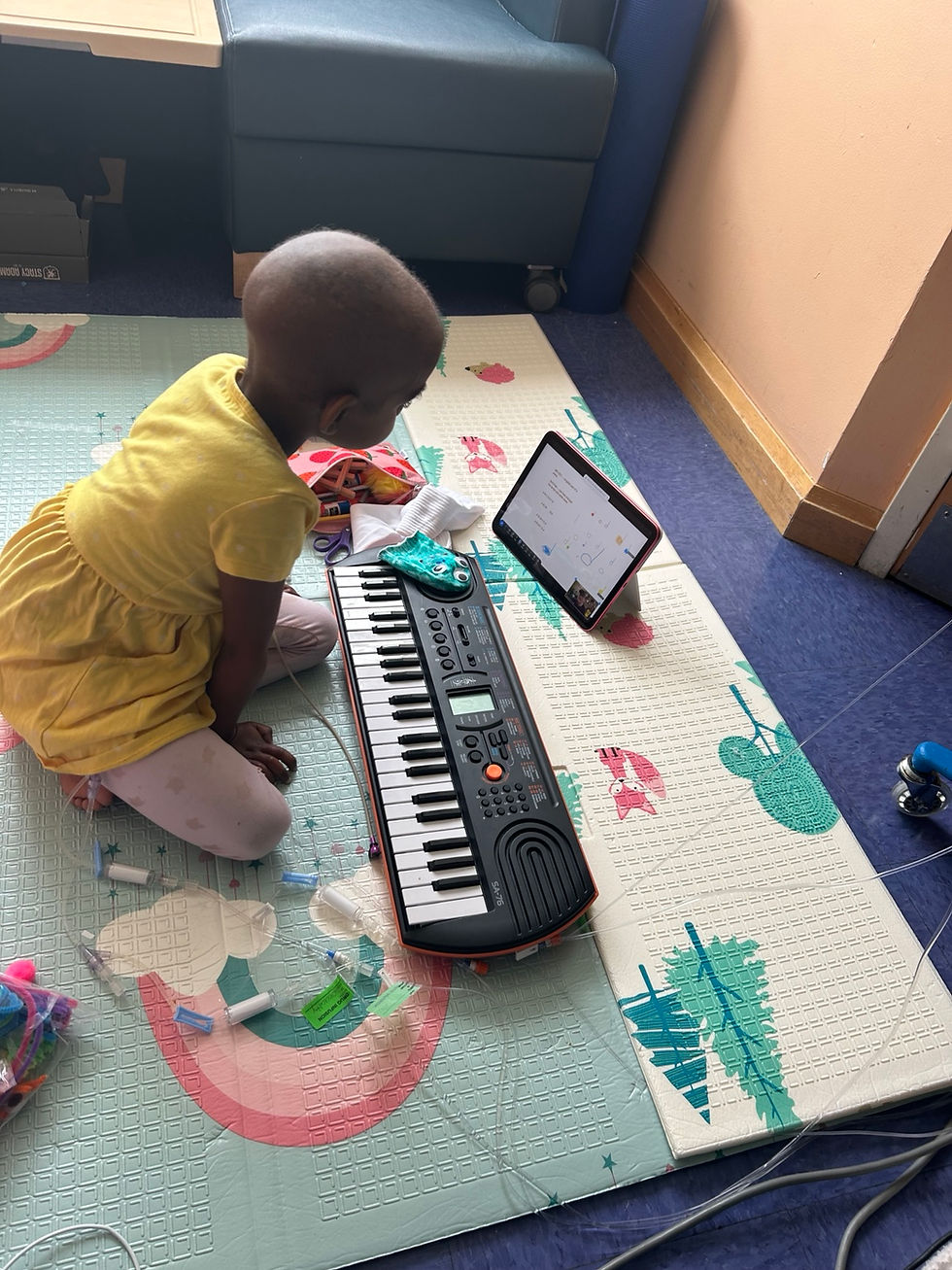
The puppet became an extension of her imagination, a way to maintain normalcy when everything else about her life had changed. Together with Skittles, we went to the zoo (built one using toys), had a fishing trip in a kiddie pool with magnetic fish and reels, and built a campfire out of paper that we sat around and ate smores. At one point, I joked to family and friends about Skittles being a little reminiscent of Wilson in Castaway—a not entirely inappropriate comparison.
What felt like pure survival instinct at the time—a five-year-old creating a companion to break through the loneliness—turns out to be backed by decades of research. Therapeutic play and companion objects provide hospitalized children with a non-threatening way to express emotions, gain a sense of control, and process their experiences (The Butterfly Pig, 2023; Connections Family Center, 2024). Through play and imaginative companions, children can give voice to fears they may be unable to express verbally and maintain developmental continuity even when their world has shrunk to the size of a hospital room (Stony Brook Medicine, 2023).
The evidence is remarkably consistent: therapeutic play interventions reduce anxiety and negative emotional responses in hospitalized children, improve behavior and coping during invasive procedures, and decrease postoperative pain and anxiety (Li, H.C.W., & Lopez, V. Journal for Specialists in Pediatric Nursing, 2008; Godino-Iáñez, M.J., et al. Healthcare, 2020). Play isn't a distraction from care—it is care.
Why Skittles Mattered: The Research Behind the Puppet
Rona didn't create Skittles as part of a child life intervention. She made a green alien puppet in a virtual class and decided he was her friend. But what research tells us is that objects like Skittles—therapeutic companions, puppets, and creative play objects—are preventative treatment for known trauma-related outcomes that children navigating complex illness experience.
Studies show that play allows children to regain a sense of predictability in an unfamiliar environment and provides agency when nearly every aspect of their lives is controlled by treatment protocols (Coyne, I., et al. Journal of Clinical Nursing). For Rona, Skittles represented something she could control when the big decisions—whether to have another transplant, whether to endure another painful procedure—were never really choices at all.
Research examining children's participation in healthcare decisions confirms this pattern: while children often cannot refuse life-saving treatment, they can be given small decisions about how care is delivered, choices that help them feel more in control and build trust with clinicians (Coyne, I., et al. Journal of Clinical Nursing). Skittles gave Rona agency, companionship, and a way to stay connected to play—the natural language of childhood—even when everything else felt impossible.
The PTSD We Don't Talk About
Here's what the research won't tell you, but lived experience will: PTSD from pediatric hospitalization doesn't end when discharge papers are signed.
Parents report persistent traumatic stress symptoms associated with prior trauma exposure, prior psychopathology, and more severe acute stress during the child's admission (Balluffi, A., et al. Pediatric Critical Care Medicine, 2004; Bronner, M.B., et al. Journal of Pediatric Psychology, 2010). The strongest predictor of parental PTSD isn't objective measures of a child's severity of illness—it's parents' subjective perceptions about their child's life-threat (Balluffi, A., et al., 2004). The fear that your child might die, the helplessness of watching them suffer, the secondary trauma of witnessing other children and families in crisis—these stay with you.
For children, the impact is equally profound. Extended hospitalizations are frequently associated with psychological stress and trauma, which is why interventions that support coping and emotional processing matter so much (Abela, K.M., et al. Journal of Pediatric Nursing, 2020). Yet access to child life programs and therapeutic play varies widely between hospitals, often depending on funding and staffing rather than evidence-based need.
What Skittles Taught Us About Survival
Skittles didn't cure Rona's illness. The puppet didn't prevent PTSD—for her or for us. But Skittles gave Rona a way to stay herself when the hospital threatened to reduce her to a diagnosis.
That matters more than I can articulate.
This PTSD Awareness Month, I want us to expand our understanding of trauma beyond battlefields and disaster zones. Pediatric ICUs are trauma zones, too (Frontiers in Pediatrics, 2025). The children who survive them—and the families who live through watching—carry that weight long after the medical crisis resolves.
Play, imagination, and yes, even a green alien puppet created in a virtual class, aren't luxuries in pediatric care. They're evidence-based interventions that help children process trauma, maintain identity, and find agency in impossible circumstances (Li, H.C.W., & Lopez, V., 2008; Silva, R.D., et al. Journal of Pediatrics, 2017). We need to fund child life programs, provide virtual learning opportunities that allow hospitalized children to create and play, train clinicians in trauma-informed care, and recognize that psychological safety is clinical safety.
Because for kids like Rona, surviving isn't just about making it out of the PICU alive. It's about making it through with their spirit intact. Sometimes that spirit lives in a green alien named Skittles.
References:
Balluffi, A., Kassam-Adams, N., Kazak, A., Tucker, M., Dominguez, T., & Helfaer, M. (2004). Traumatic stress in parents of children admitted to the pediatric intensive care unit. Pediatric Critical Care Medicine, 6(5), 547-53.
Bronner, M.B., Peek, N., Knoester, H., Bos, A.P., Last, B.F., & Grootenhuis, M.A. (2010). Course and predictors of posttraumatic stress disorder in parents after pediatric intensive care treatment of their child. Journal of Pediatric Psychology, 35(9), 966-974.
Colville, G., & Pierce, C. (2012). Children's trauma following PICU admission. Intensive Care Medicine.
Coyne, I., Amory, A., Gibson, F., & Kiernan, G. Children's participation in shared decision-making: Children, adolescents, parents and healthcare professionals' perspectives and experiences. Journal of Clinical Nursing.
Godino-Iáñez, M.J., et al. (2020). Play therapy as an intervention in hospitalized children: A systematic review. Healthcare.
Herrup, E., et al. (2017). Post-intensive care syndrome: Surviving the pediatric ICU. CHOC Review.
Li, H.C.W., & Lopez, V. (2008). Effectiveness and appropriateness of therapeutic play intervention in preparing children for surgery: A randomized controlled trial study. Journal for Specialists in Pediatric Nursing, 13(2), 63-73.
Silva, R.D., Austregésilo, S.C., Ithamar, L., & Lima, L.S. (2017). Therapeutic play to prepare children for invasive procedures: A systematic review. Journal of Pediatrics (Rio J), 93(1), 6-16.


Comments